August 20, 2026
The Real AI Opportunity for Communications Teams

Note: This post is authored by Just Drive Media's founder and CEO, Ali Winkle.
When ChatGPT first showed up, communications teams did what communications teams do: We put it to work on content.
The blank prompt box quickly became a junior copywriter with infinite patience. It could take a first pass at a press release, turn a blog post into six social posts, clean up meeting notes and generate more subject lines than anyone could possibly want. With a bit more effort, it could help develop media pitches, ad copy and even a marketing strategy.
That was the obvious place to start. Content is visible, time-consuming and relatively easy to experiment with. It is also only the front door.
AI becomes far more valuable when it can draw upon everything an organization knows, process the enormous volume of information coming from the outside world and find connections across both.
That takes far more than a well-written prompt.
The context behind the content
Anyone who has tried to use AI for serious communications work has run into the context problem.
You ask for a strategy and get something polished but generic. You give it a brand book and the language improves, but it still misses the history behind the brand: the product decision that changed the positioning, the feedback from customers who interpreted the last campaign differently than expected, the idea the leadership team debated for three months before finally abandoning it.
AI works from the context it receives. When that context is thin, the work usually is too.
This is why so many organizations have moved from talking about prompt engineering to talking about context engineering. The quality of the work changes dramatically when AI has access to the company’s strategy, customer intelligence, voice, business rules and examples of what “good” looks like.
Still, most of that work remains remarkably individual.
Emily Kramer describes this as “single-player Claude.” One person builds a useful workflow. Someone else creates a skill. A third person figures out how to get consistently strong output from a particular model. Each person gets better, while most of that learning stays tucked inside their own account and their own way of working.
Her vision for “multiplayer Claude” is much more compelling: shared context and capabilities that improve as more people use them. If one person develops a better way to analyze customer feedback, the entire team gains that capability. If someone discovers an important nuance about the company’s positioning, it becomes part of the context available to everyone else.
Will Fernandez, Michelle Taite and John Winsor make a related case in the Harvard Business Review. They argue that companies need a machine-readable “brand code” containing the strategy, customer intelligence and business rules that people and AI agents can work from.
That would be a meaningful leap forward for most organizations.
The larger opportunity, however, is to build a system that also retains the thinking surrounding the work.
By the time a strategy becomes a deck, much of the messy thinking that produced it has been stripped away. The questions, disagreements, customer comments, half-formed ideas and judgment calls tend to disappear during the editing process. The document tells us what the team decided, but often very little about how it arrived there.
That missing context is where much of an organization’s real intelligence lives.
Building a company that remembers
I became mildly obsessed with the idea of “building a second brain” in 2022.
The concept, popularized by Tiago Forte, is fairly simple: Instead of allowing everything you read, notice and learn to disappear into a notebook or an impressive collection of open browser tabs, you save it somewhere useful. You connect ideas by topic, theme or project so you can find them again and continue building on them.
As an incessant note-taker whose notebooks tend to become little time capsules of thoughts I never revisit, I immediately saw the appeal. I started saving articles, book highlights, podcast excerpts and my own notes on leadership, culture and peak performance.
A few months later, we began doing the same thing as a team at Just Drive Media.
We used Notion to collect articles that might be useful for client work, observations we wanted to remember, feedback we had received and approaches we wanted to carry into future engagements. Some of it looked like organized hoarding. To be fair, some of it probably was.
But it also began to pay off. My notes on culture and leadership helped me build a Maven course on high-performing teams. Readwise highlights supplied ideas and quotes for company all-hands calls. Podcast excerpts sparked conversations with our team and clients. Lessons from one project made their way into another.
The vision was always larger than a well-organized library. I wanted to build a shared knowledge graph where one person’s observation could connect with another person’s experience, even if they worked on different clients or made those observations years apart.

The available technology made that hard. The most sophisticated knowledge graphs I had seen required people to spend a great deal of time manually linking notes and maintaining the structure. That may be workable for one highly committed person. It becomes a much heavier lift for a remote team with clients and deadlines.
So we kept building what we could.
AI has now made the original vision much more practical. It can search across a large body of information, recognize similarities in ideas expressed with completely different language and surface a relevant connection without someone having created the perfect tag three years earlier. The knowledge we were already collecting can travel much farther.
And that is only the internal side of the equation.
Giving the company a set of senses
A company also needs a useful view of what is happening beyond its own walls. The outside world produces information about the business every day, much of it in places that do not fit neatly into a communications dashboard.
There are the obvious sources such as media coverage and social conversation. There is also branded search behavior, NPS and voice-of-the-customer research, support tickets, sales calls, employee sentiment, website activity and the answers people receive when they ask ChatGPT or another AI platform about the company.
Each source offers a slightly different view of how the brand is understood.
A product launch may earn glowing coverage while sales calls reveal that customers still do not understand what the product does. A message gaining traction on social media may never show up in search behavior or customer language. Meanwhile, customers may describe the company in words that are far more interesting than anything in the official messaging document.
For years, teams have tried to make sense of these signals through a combination of dashboards, reports, spreadsheets and very determined analysts. Access to information has expanded much faster than our ability to absorb enough of it at once to see what is actually happening.
A Caltech analysis puts that mismatch into perspective. The researchers estimate that our sensory systems collect information at roughly a billion bits per second, while the rate at which we consciously think and act is closer to 10.
The numbers are so far apart that it’s astounding. No wonder we so often feel overwhelmed! We are surrounded by a torrent of information yet able to direct our attention toward only a tiny fraction of it.
Communications teams feel some version of this pressure every day. There will always be more coverage to read, more conversations to follow and more customer feedback to read than any team can fully process. Adding another dashboard simply gives us another place to look.
Yet, there is hope…
AI can hold more of that landscape in view at one time. It can compare sources that have historically been analyzed by different teams, look for relationships across longer periods and bring potentially meaningful patterns to the surface.
Thinking of this system like a giant brain is a useful analogy, because a brain stores memories while continually receiving and interpreting new signals. In an organization, the knowledge base provides the memory. Analytics brings in the senses. AI helps manage the volume and uncover patterns and relationships across the many bits of information, and people contribute the experience and judgment that turn a pattern into a decision.
That combination is already producing extraordinary results in other fields.
Researchers studying liver disease recently asked Google DeepMind’s Co-Scientist why an approved treatment helped only a narrow group of eligible patients. The system worked across research in liver biology and pharmacology and surfaced a possible mechanism that had not previously been brought together into one explanation. The researchers tested the hypothesis, and it held up.
The scientists framed the question, recognized a promising answer and proved it experimentally. AI gave them a much larger field of vision.
X, the Moonshot Factory, is exploring a similar idea for people working across huge collections of private information: a lawyer comparing a deposition against millions of pages of case history, or a doctor making sense of decades of scattered medical records.
Steven Kotler and Peter Diamandis describe capabilities like these as nearly godlike in their book We Are As Gods. The phrase is intentionally provocative, but it captures the scale of the shift. Human expertise can travel much farther when experts are able to see relationships hidden inside more information than they could ever examine on their own.
Communications may be a less dramatic example than discovering a new disease mechanism, but the underlying challenge is familiar. We are also looking for patterns inside a complicated system: how a company is perceived, what is shaping that perception and whether its actions and communications are changing it.
Bringing the two sides together
For nearly 20 years, our analytics work at Just Drive Media has asked some version of the same question: What is the outside world telling us that is not making it back to the people who need to hear it?
In the early days of social listening, we helped companies like eBay, Skype and LinkedIn understand what people were saying about them in real time. Those insights became much more useful when they traveled beyond the social media team: when a customer complaint reached the product team, an emerging issue changed the communications response or a shift in conversation gave company leaders a clearer picture of what the market believed, real business impact was seen.
Over time, analytics became foundational to how we work, because it helped clients see patterns no single metric, tool or dashboard could reveal. Yet, even that approach has always had a limit. The amount of information a human team can reasonably collect, compare and translate into useful recommendations will always be limited by budgets and human capacity.
Now, AI expands the number and variety of signals we can work with.
It also creates the possibility of connecting that external picture with the organization’s accumulated internal knowledge.
With those systems connected, a team can recognize that a concern surfacing in sales calls resembles feedback from an earlier product launch. It can see that language first tested in an executive interview is beginning to travel through media coverage, social conversation, search and AI-generated answers. A customer observation buried in a meeting note six months ago may help explain a narrative shift happening now.
This is the capability we are building toward at Just Drive Media, both in the way we use our own shared knowledge and in the intelligence we provide to clients. It grows naturally out of work we have already been doing. AI allows us to work across vastly more sources of information, and make the connections much faster.
When organized effectively, a system like this becomes more useful as learning flows back into it. Like a living brain, its ability to generate insight is only limited by what an organization is willing to put into it. Meeting notes, project debriefs, product feedback, experiments, results and the reasoning behind key decisions all add context. Over time, the organization develops a deeper memory of what it has tried, what it has learned and how the market responded.
What this means for communications teams
Communications leaders have an important role to play here. Our work already crosses many of the boundaries that make this difficult. We sit between leadership and employees, company strategy and public perception, the story the organization wants to tell and the evidence the market is actually seeing.
The practical challenge will be as human as it is technical. People have to change how they document decisions, share what they know and contribute to a common system. Teams need to see that adding their experience makes future work better instead of becoming another administrative obligation. AI adoption at this level depends heavily on change management and internal communication—work communications leaders understand well.
A system like this grows through use, correction and continued attention. That is how it becomes a living part of the organization rather than another repository everyone forgets to check.
The advantage will compound over time. Every decision, signal and correction gives the system more context. Years from now, the meaningful gap between organizations will be the depth of memory their people and AI can draw upon.
Competitors have access to the same AI models you do. The years of accumulated knowledge, learning and judgment will be much harder to reproduce.
That is a much bigger opportunity than writing another press release faster.
_______________________________________________
Frequently Asked Questions
How can communications teams use AI beyond content creation?
AI can help communications teams process and connect information from media coverage, social conversations, customer feedback, search behavior, sales calls and other sources. This gives teams a broader view of how a company is perceived, which narratives are gaining traction and where the market’s understanding differs from the company’s intended positioning.
Why is organizational context important when using AI?
AI produces better work when it understands the company’s strategy, customers, voice, business rules and history. Without that context, outputs tend to be generic. Giving AI access to shared organizational knowledge allows it to produce recommendations and analysis grounded in the company’s actual experience.
What belongs in a shared organizational knowledge base?
A useful knowledge base includes more than finished documents. It can contain meeting notes, customer feedback, project debriefs, campaign results, product decisions, research, experiments and the reasoning behind important judgment calls. Capturing this information helps future teams learn from work that has already been done.
What is LLM visibility, and why should communications teams track it?
LLM visibility refers to how a company, product or executive appears in answers generated by platforms such as ChatGPT, Claude and Google’s AI experiences. Tracking these answers can reveal which sources and narratives are shaping AI-generated perceptions of the brand, whether important messages are appearing accurately and how the company compares with competitors.
How can AI help measure communications impact?
AI can analyze signals across media, social platforms, search, website activity, customer feedback, sales conversations and AI-generated answers. Looking at these sources together helps communications teams identify changes in narrative, visibility and audience perception and build a stronger body of evidence around the impact of their work.
What role should communications leaders play in AI adoption?
Communications leaders are well positioned to connect company strategy, employee understanding and external perception. They can also help lead the change management and internal communication required for teams to document what they know, share useful context and adopt new AI-enabled ways of working.
Related Stories

Communications Has an Intelligence Advantage. It’s Time to Use It.
Impressions and share of voice describe what happened, not why. A better approach to measuring communications effectiveness, and what it asks of comms teams.
September 15, 2026

Beyond GEO: How Communications Shapes What AI Knows About Your Brand
Stop treating GEO as a new channel. A diagnostic framework for finding the influence gap behind how AI describes your brand, and choosing the right fix.
September 9, 2026

LinkedIn in 2026: What Matters Now
Explore the latest LinkedIn best practices for profile optimization, content strategy, engagement, and executive visibility to strengthen your professional presence.
June 17, 2026

How YouTube Is Reshaping B2B Buyer Research
Based on an analysis of 135 videos, learn how buyers discover, evaluate, and choose solutions—and what it means for your B2B marketing strategy.
April 27, 2026

Influence Architecture: How Modern Brands Are Actually Built
Modern brands build trust with Influence Architecture: aligning performance, narrative, visibility, and credibility into a system that compounds over time.
April 14, 2026

Built With, Not For: The Case for Developer Education as Advocacy
Developer education drives advocacy when it lowers the barrier to entry, builds confidence, and helps people see where and how they can participate.
February 5, 2026

Social Media for Executives: The Influence Economy Has Come for the C-Suite
Discover how top Inc. 5000 executives are driving influence and building credibility through authentic, human social media content.
October 20, 2025

From Upvotes to Influence: How Reddit Marketing is Redefining Brand Trust Online
Learn how Reddit marketing is reshaping brand trust, search visibility, and AI results in 2025, and how your brand can win on the platform.
October 9, 2025

The Rise of GEO: What Brands Must Do to Stay Visible in an AI-First Search Era
Search is changing fast. Discover how to shift from SEO to GEO and keep your brand visible in AI-driven, zero-click search results.
August 19, 2025

The Rise of the Employee-Influencer: Why Your Best Advocates Might Already Be on Payroll
Explore the growing power of employee advocacy and how companies can harness the authentic voices of their teams to build trust, expand reach, and strengthen their brand.
July 28, 2025

The AI Power Players: Who’s Influencing the Narrative? And What Can Business Leaders Learn from These Voices?
Who’s shaping the conversation around AI, and how? We analyzed the data to spotlight the most influential voices driving public opinion, platform adoption, and policy.
March 27, 2025

AI, Adaptability, and Autonomy: The Future of Marketing Belongs to Those Who Invest
Marketing is changing with incredible speed. Learn how transparency, tools, and trust can help you and your team harness the chaos.
December 20, 2024

LinkedIn Creators Are Changing the Game for B2B Marketing - Are You Ready?
Discover how LinkedIn creators can help humanize your B2B marketing, build trust, and drive stronger connections—an untapped opportunity many brands are missing.
November 18, 2024

Why Executive Communication Is More Critical Than Ever, and How to Do It Right
Learn why executive communications are key to building trust, engagement, and visibility, and how that impacts business results.
November 13, 2024
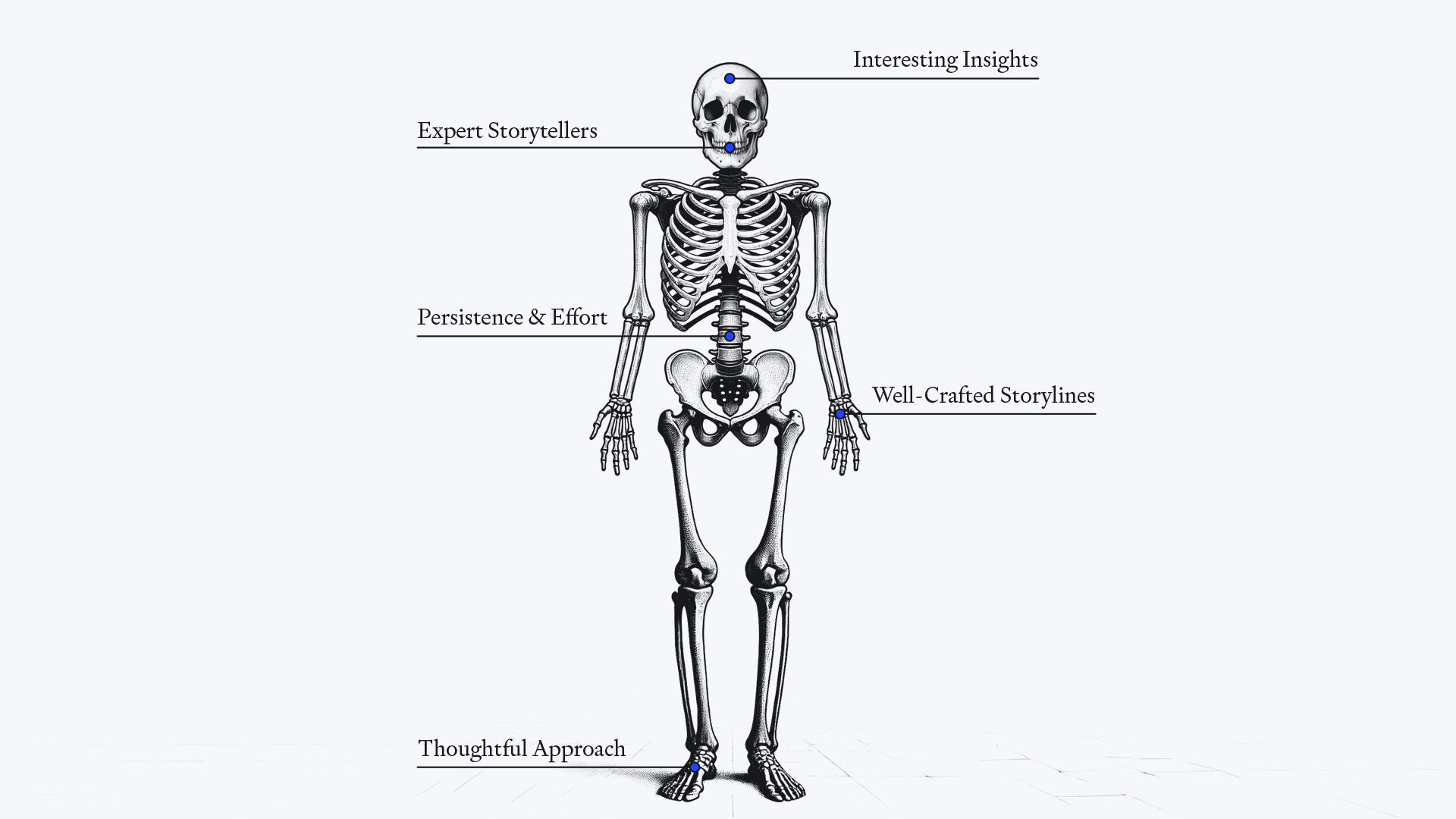
Anatomy of Coverage: How to Break Through to Media
These 5 elements consistently drive media coverage.
August 8, 2024
The Art of Listening: From Diverse Signals to Business Value
Measuring content strategies to determine what's driving the most value can be tricky. Here's what to think about when it comes to media measurement, social listening, and brand signal analysis.
May 21, 2024

Uncovering The “Who” Behind Your Social Audience
Discover how understanding your audience's diverse segments can unlock new strategies for engagement and growth—dive into the art and science of audience analysis.
June 5, 2023

How To Plan Ahead For a PR Crisis
Ever wonder how top brands navigate a PR crisis? Check out this guide to learn how to craft a solid strategy that will protect your brand's reputation.
October 6, 2022

5 Questions Before Hiring A PR Agency
Before you leap into the world of PR, make sure you're ready for primetime. Peek inside to learn how to set your team up for success and get the most out of a PR partnership.
August 18, 2022

Stop Fighting Social Algorithms And Do This Instead
Struggling to keep up with social media algorithms? Find out how a simple shift in your content strategy can dramatically boost your brand's presence.
August 3, 2022
The Unique Challenges And Opportunities Of B2B Influencer Marketing
Influencer marketing isn't just the realm of consumer marketers. See why it's a hidden gem for boosting trust and referrals for B2B, too.
July 6, 2022
Is Podcasting Your Next Big Move? Why It's Time to Tune In.
Is your brand ready to amplify its voice? Dive into the podcasting wave and learn why it might be the strategic play your business shouldn't miss.
June 15, 2022

5 Steps To Running A Smooth AMA On Social Media
Ready to host an AMA that sparks conversations and connects deeply with your audience? Dive into our five essential steps for a seamless social media event.
May 12, 2022
Inside Our Metric Ecosystem - And Why It Wins Awards
Explore the foundation of our award-winning methodology and learn how we tap the power of social data for better decision-making.
May 1, 2018

The Myth Of Insta-Media Coverage & The Truth About "Big" Placements
Aspiring to achieve launch-day headlines? Pull back the curtain on the real strategies and tactics behind major media attention.
November 9, 2017